One of the greatest barriers to the acceptance of psychotherapies that stimulate acupuncture points by tapping on them, such as EFT and TFT, has been a persistent question: How does tapping on the skin lead to psychological change?
For decades, practitioners have known that therapies and self-help approaches involving tapping on acupuncture points are unusually fast and effective, but articulating a clear, science-based explanation has been more challenging. Over the past two decades, researchers such as Dawson Church, Peta Stapleton, and David Feinstein have steadily advanced the evidence base through peer-reviewed studies. In November 2025, David published a landmark synthesis of this research, offering the most coherent and comprehensive scientific account to date of the physiological and psychological mechanisms underlying EFT and TFT.
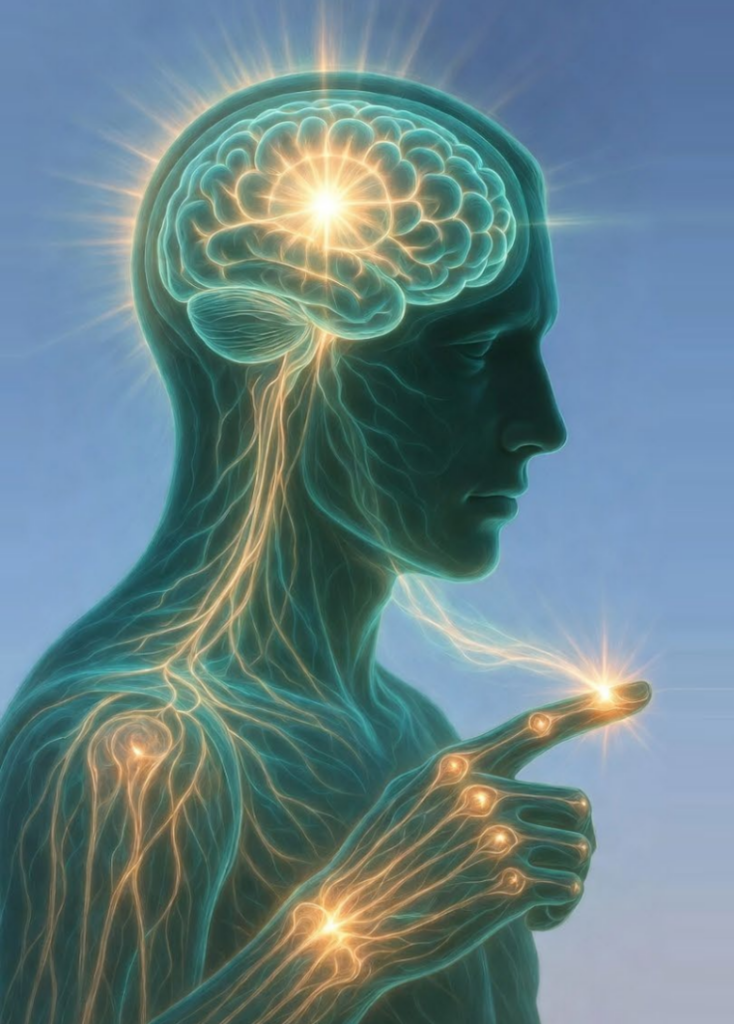
Recognizing the importance of this work — and knowing that most practitioners don’t have time to read lengthy academic papers — Nick Ortner used AI to translate the research into a beautifully designed, 10-page illustrated infographic. David then reviewed the entire piece, making numerous corrections and refinements to ensure scientific accuracy. It is perhaps the most engaging, accessible, and efficient way available to become conversant in the science behind tapping.
Tapping, the most comprehensive book on Energy Psychology, is written for professionals as well as the general public. Learn more.
Translations of the Infographic Are in Progress. Check Back Soon.
QUESTIONS AND COMMENTS INVITED
Because it is so vital for the field’s acceptance within the mental health community to have a plausible explanation for how acupoint tapping protocols produce the strong outcomes consistently reported in more than 300 peer-reviewed clinical trials – not to mention how interesting that question is – we invite a dialogue. David will check and respond to your questions and comments at least once a week until the questions taper off.
32 Responses
David Feinstein & Nick Ortner, this is fantastic! Thanks so much for sharing.
Thank you for your continued research into the efficacy of energy medicine. I am curious why the primo-vascular system is not mentioned. A video produced by Dr. Stapleton about two years ago mentioned that the primo nodes appear to align with meridian points, which may provide anatomical evidence for the meridian system. I often lead with that when I tell people about tapping so I’m interested in whether additional research has lessened the emphasis on this system. Thank you, again. https://www.youtube.com/watch?v=GMa6Dv4OUrc
Hi Carolyn, even though the primovascular system was described 50 years ago, research establishing that it is the anatomical basis of the meridian system is still preliminary and controversial in some circles. In my opinion, it is a promising candidate. Using it to explain acupuncture has scientific merit as long as you use terms like “probable” rather than “established.” It was not possible to include many many details in the infographic, but the paper the infographic summarizes (link to it is on the bottom of the first page of the infographic) references this 2023 paper by Nan et al,:”The involvement of the primo vascular system in local enteritis and its modification by electroacupuncture.” Thank you for bringing attention to this little known system that may have important implications for understanding acupuncture points and meridians.
Whew
I am no physician by far.
I know you are looking for the analytical.
I’d simply like to suggest you not try to make/push/shape the spiritual body into a physical entity.
Let go…….
Seriously, it feels awesome to …
not think.
No drugs involved.
Embrace being inside your breath.
That is where the energy is/ It is not anatomical.
By all means, Micah, share it as widely as you wish. Our preference is that you link to the URL https://energytapping.com/how-tapping-works-infographic/
rather than post it on your site so people can engage in the discussion.
This infographic is excellent. Given all of the interest in Polyvagal theory plus the fact that Stephen Porges has said that he thinks many of the tapping points on the face, plus the rhythmic aspect of tapping would stimulate the vagal, what are your thoughts on the vagal nerve being part of the transmission system
Yes, this is an appealing line of reasoning. While we don’t yet have point-for-point research to establish a direct connection, here are the two reasons I believe that connection is waiting to be empirically demonstrated: 1) the known functions of the polyvagal system and the outcomes of acupoint tapping protocols, as established in a large number of clinical trials, overlap. Activation of both appear to shift the autonomic nervous system from defensive states (fight/flight, shutdown) to safety and engagement — with associated physiological and psychological shifts such as reductions in heart rate, blood pressure, cortisol, and subjective arousal, and 2) the polyvagal system can be activated by gentle touch, rhythmic stimulation, and kind facial expressions, all of which are part of acupont tapping protocols. So a strong theoretical argument can be made for, in your words, “the vagal nerve being part of the transition system.” The empirical connection waiting to be made (as far as I know this hasn’t yet been done) is to show using laboratory measures that EFT protocols stimulate the vagal nerve fibers.
This makes so much sense! Thank you so very much David & Robert for this important text exchange above. Excited for more research to follow this seemingly plausible path, including the vagal nerve…if anyone reading this wants to conduct research, I would likely be able to assist with securing potential clients(for EFT) through a mental health nonprofit.
Thank you so much for all the work you have carried out over the years and for publishing this wonderful resource and to Nick Ortner too for helping create such a lovely document. Amazing!
David, and all involved this is brilliant! A clear, compelling, and accessible summary.
There is a typo in the boxed text in the section Supporting Studies/Durability “while EFT OUTCOM outcomes…”
Only other comment is that the positioning of the label for step 3 of the 5 Step Journey, in the diagram, seems
slightly unusual to me at first glance as it is still some way from the brain?
Thank you for all you’re doing with this work, congratulations and best wishes 🙂
Thanks so much for this wonderful resource. I will be sharing this liberally with my students and clients. Looking back to the many years I was tapping without clear understanding of the science, it is marvelous to see clear evidence for the calm we knew resulted from this intervention.
This is so clear, so so helpful. I am sharing it with everyone, especially in my trainings for clinicians. Thank you so much. One question —is what you are calling neural reconsolidation the same as memory reconsolidation? Mary
Thank you, Mary. Great question because it shows how the understanding of memory reconsolidation is evolving. I am using “neural reconsolidation” to mean the same basic process that is usually called “memory reconsolidation.” I prefer the broader term because what is being updated is not only autobiographical memories but also the underlying mental models that generate expectations, emotions, and behavioral responses. I’d not seen this term before I started using it, but I’ve since learned that a few others have used it before me. It’s simply more accurate when referring to the changes brought about by psychotherapy.
Hi David!
“Neural reconsolidation” makes so much sense and thanks for this clear explanation of it. Thanks also for working with Nick Ortner to create this terrific, user-friendly infographic based on your article. You just rock.
Be well
Thank you so much for this!!!!
I have recently co-authored a book to be published by Routledge on ADHD relationships.
It contains a lot of tapping nothing for the ADHD partner and the non-ADHD partner
How can I reference this excellent info graphic for the readers?
Congratulations, Debbie. Routledge is an excellent choice! I’m not sure you mean “nothing” in your note, but I’m pleased you would like to reference the infographic. Simply list the URL: https://energytapping.com/how-tapping-works-infographic/. See the suggested framing in my reply to Micah Saviet above and work from that.
Thank you, Lynn. The URL to the infographic, as you know, is https://energytapping.com/how-tapping-works-infographic/ In the lower right of the first page is the link to my academic paper, HOW TAPPING WORKS, on which the infographic is based. Meanwhile, at the top of the page is a tab to the home page of my website.
Hi David and Nick,
I tried Tapping a few years ago and admittedly, didn’t spend long enough with it to see if it worked. I am enrolled to attend the master classes starting soon, as I am going through a very bad emotional time at present. I realised I was sceptical as I had dabbled in a few Chinese acupressure sessions and noticed how very specific the acupressure points were. In following the method in the original book on Tapping, I was disappointed to see how loosely defined the points were. The meridians in Chinese medicine are so fine, that a millimetre ‘off’ can cause havoc on the system. Can you please explain how this system works within such a ‘broad’ area of work on the body. The face seems to be far easier to pinpoint the areas to tap, however the areas under the arms seem to be more vague and unspecific?
Looking forward to some clarification on this. And to attending the workshops.
Warm regards
Frannie
p.s. I am not a medical practitioner, only a desperate seeker for a lower stress response!
Dear Frannie, first of all, I hope the classes will be highly valuable for you personally in the challenges you are facing as well as highly instructive about the method. You raise a very interesting and fundamental question, and one that can only be resolved by research that has not yet been conducted: Would people who use the manualized Clinical EFT protocol and are tapping on the acupuncture points precisely where they are located obtain stronger results than people who whose tapping is a few centimeters off from the exact point locations.? Until such studies are conducted, here is what we do know from research. 1) In studies that compare specific health or mental health benefits of stimulating acupuncture points with the benefits of stimulating “sham” points (points not recognized as acupuncture points), the acupuncture point stimulation showed superior results, but the sham points also produced health or mental health benefits, depending on the study, and 2) while acupuncture points have a greater concentration of mechanosensory receptors (cells that convert mechanical pressure into electrical signals) and greater electrical conductivity, non-acupuncture points also have both properties, just to a lesser degree. These findings suggest that the act of stimulating other points than the true acupuncture points may have a beneficial effect, though this has not been established through research on acupoint tapping for psychological benefits per se. In terms of the infographic, to what degree would tapping on sham points initiate the cascade of physiological events portrayed? Another pertinent observation made by acupuncturists who have learned EFT is that an advantage of tapping over the traditional needling of acupuncture points for people with minimal training in locating the exact points is that tapping sets up a vibration so that even if you aren’t on the exact point, that point will still be stimulated. This does not occur with needling. Great question, thank you!
This is so great to have – as someone who uses various tapping protocols over the years, with good results, I can now explain better to skeptical friends and family. And you two working together, David and Nick, GOLDEN! thanks!
Thank you so much for this information – it makes so much sense and allows me to explain what I’m doing when asked by others. I’ve tried tapping on a few occasions but was never completely convinced about whether it would work – I now have the science to back it up. Thank you.
I first learned to tap with Roger Calaghan, some 30 years ago. I have also practiced accupressure for many years. (The method I learned is called Jin Shin Jyutsu). I am curious whether the pressure on points or the tapping on points is more effective. Any research on that? Thanks for the research!
While I know of no research that compares pressure on acupressure points vs. tapping on them, Jin Shin Jyutsu, with its emphasis on sustained holding the points, clearly works for many people, and your own experience over the years with it and with TFT is probably your best guide, Kalya. Here are my thoughts. I believe that tapping is generally more effective, at least for addressing psychological problems. The advantage of tapping is that it is presumably more capable of sending impulses through the body. The body is accustomed to impulses. The beating of the heart sends impulses through the circulatory system, so rhythm is native to the body. The body doesn’t reflexively resist gentle tapping. It instead puts it to use. Tapping appears to send impulses through the body’s connective tissue., with the fascia acting as a signaling network. This is different from the electrical signals that tapping (or pressure) generates at the cellular level, but I suspect it has its own impact (though still unmapped). Meanwhile, tapping isn’t for everyone. For some people, holding the points is more effective. Tapping may feel disruptive to them, or even invasive. Holding will feel more peaceful. John Diepold’s “Touch and Breathe” method is oriented toward holding the points rather than tapping on them, and the deep breathing engages the vagus nerve and also sends impulses through the body.
WOW! This is the clearest, easy-to-follow-and-understand, best-illustrated, science-backed explanation for how acupoint tapping works as a psychological tool that I’ve seen. Congratulations to you and Mr. Ortner!


David Feinstein & Nick Ortner, this is fantastic! Thanks so much for sharing.
Awesome..thank you!
This is an EXCELLENT resource to share with clients! Thank you for putting this together!
Thank you for your continued research into the efficacy of energy medicine. I am curious why the primo-vascular system is not mentioned. A video produced by Dr. Stapleton about two years ago mentioned that the primo nodes appear to align with meridian points, which may provide anatomical evidence for the meridian system. I often lead with that when I tell people about tapping so I’m interested in whether additional research has lessened the emphasis on this system. Thank you, again. https://www.youtube.com/watch?v=GMa6Dv4OUrc
Hi Carolyn, even though the primovascular system was described 50 years ago, research establishing that it is the anatomical basis of the meridian system is still preliminary and controversial in some circles. In my opinion, it is a promising candidate. Using it to explain acupuncture has scientific merit as long as you use terms like “probable” rather than “established.” It was not possible to include many many details in the infographic, but the paper the infographic summarizes (link to it is on the bottom of the first page of the infographic) references this 2023 paper by Nan et al,:”The involvement of the primo vascular system in local enteritis and its modification by electroacupuncture.” Thank you for bringing attention to this little known system that may have important implications for understanding acupuncture points and meridians.
Whew
I am no physician by far.
I know you are looking for the analytical.
I’d simply like to suggest you not try to make/push/shape the spiritual body into a physical entity.
Let go…….
Seriously, it feels awesome to …
not think.
No drugs involved.
Embrace being inside your breath.
That is where the energy is/ It is not anatomical.
Yes AND, IMHO, each perspective has value. Thank you for speaking up, Deanna, for the spiritual dimension amidst this discussion of the physiological.
Thank you so much! Are we allowed to share this with clients and post on our websites? How do we cite this?
By all means, Micah, share it as widely as you wish. Our preference is that you link to the URL https://energytapping.com/how-tapping-works-infographic/
rather than post it on your site so people can engage in the discussion.
This infographic is excellent. Given all of the interest in Polyvagal theory plus the fact that Stephen Porges has said that he thinks many of the tapping points on the face, plus the rhythmic aspect of tapping would stimulate the vagal, what are your thoughts on the vagal nerve being part of the transmission system
Yes, this is an appealing line of reasoning. While we don’t yet have point-for-point research to establish a direct connection, here are the two reasons I believe that connection is waiting to be empirically demonstrated: 1) the known functions of the polyvagal system and the outcomes of acupoint tapping protocols, as established in a large number of clinical trials, overlap. Activation of both appear to shift the autonomic nervous system from defensive states (fight/flight, shutdown) to safety and engagement — with associated physiological and psychological shifts such as reductions in heart rate, blood pressure, cortisol, and subjective arousal, and 2) the polyvagal system can be activated by gentle touch, rhythmic stimulation, and kind facial expressions, all of which are part of acupont tapping protocols. So a strong theoretical argument can be made for, in your words, “the vagal nerve being part of the transition system.” The empirical connection waiting to be made (as far as I know this hasn’t yet been done) is to show using laboratory measures that EFT protocols stimulate the vagal nerve fibers.
This makes so much sense! Thank you so very much David & Robert for this important text exchange above. Excited for more research to follow this seemingly plausible path, including the vagal nerve…if anyone reading this wants to conduct research, I would likely be able to assist with securing potential clients(for EFT) through a mental health nonprofit.
Thank you so much for all the work you have carried out over the years and for publishing this wonderful resource and to Nick Ortner too for helping create such a lovely document. Amazing!
David, and all involved this is brilliant! A clear, compelling, and accessible summary.
There is a typo in the boxed text in the section Supporting Studies/Durability “while EFT OUTCOM outcomes…”
Only other comment is that the positioning of the label for step 3 of the 5 Step Journey, in the diagram, seems
slightly unusual to me at first glance as it is still some way from the brain?
Thank you for all you’re doing with this work, congratulations and best wishes 🙂
Thank you, Julie. Good eye! Both errors have been corrected. Nice to hear from you after all this time!
Thanks so much for this wonderful resource. I will be sharing this liberally with my students and clients. Looking back to the many years I was tapping without clear understanding of the science, it is marvelous to see clear evidence for the calm we knew resulted from this intervention.
This is so clear, so so helpful. I am sharing it with everyone, especially in my trainings for clinicians. Thank you so much. One question —is what you are calling neural reconsolidation the same as memory reconsolidation? Mary
Thank you, Mary. Great question because it shows how the understanding of memory reconsolidation is evolving. I am using “neural reconsolidation” to mean the same basic process that is usually called “memory reconsolidation.” I prefer the broader term because what is being updated is not only autobiographical memories but also the underlying mental models that generate expectations, emotions, and behavioral responses. I’d not seen this term before I started using it, but I’ve since learned that a few others have used it before me. It’s simply more accurate when referring to the changes brought about by psychotherapy.
Hi David!
“Neural reconsolidation” makes so much sense and thanks for this clear explanation of it. Thanks also for working with Nick Ortner to create this terrific, user-friendly infographic based on your article. You just rock.
Be well
Thank you so much for this!!!!
I have recently co-authored a book to be published by Routledge on ADHD relationships.
It contains a lot of tapping nothing for the ADHD partner and the non-ADHD partner
How can I reference this excellent info graphic for the readers?
Congratulations, Debbie. Routledge is an excellent choice! I’m not sure you mean “nothing” in your note, but I’m pleased you would like to reference the infographic. Simply list the URL: https://energytapping.com/how-tapping-works-infographic/. See the suggested framing in my reply to Micah Saviet above and work from that.
Thank you so much David. A fantastic and a very clear infographic reference to share.
Just what we need!
PS This is a fantastic infographic. Thank you. Please add the website address and author so that when it is printed it has th correct attribtion.
Thank you, Lynn. The URL to the infographic, as you know, is https://energytapping.com/how-tapping-works-infographic/ In the lower right of the first page is the link to my academic paper, HOW TAPPING WORKS, on which the infographic is based. Meanwhile, at the top of the page is a tab to the home page of my website.
Excellent, thank you very much, I love you also include fascia (conective tissue) in the explanations
Hi David and Nick,
I tried Tapping a few years ago and admittedly, didn’t spend long enough with it to see if it worked. I am enrolled to attend the master classes starting soon, as I am going through a very bad emotional time at present. I realised I was sceptical as I had dabbled in a few Chinese acupressure sessions and noticed how very specific the acupressure points were. In following the method in the original book on Tapping, I was disappointed to see how loosely defined the points were. The meridians in Chinese medicine are so fine, that a millimetre ‘off’ can cause havoc on the system. Can you please explain how this system works within such a ‘broad’ area of work on the body. The face seems to be far easier to pinpoint the areas to tap, however the areas under the arms seem to be more vague and unspecific?
Looking forward to some clarification on this. And to attending the workshops.
Warm regards
Frannie
p.s. I am not a medical practitioner, only a desperate seeker for a lower stress response!
Dear Frannie, first of all, I hope the classes will be highly valuable for you personally in the challenges you are facing as well as highly instructive about the method. You raise a very interesting and fundamental question, and one that can only be resolved by research that has not yet been conducted: Would people who use the manualized Clinical EFT protocol and are tapping on the acupuncture points precisely where they are located obtain stronger results than people who whose tapping is a few centimeters off from the exact point locations.? Until such studies are conducted, here is what we do know from research. 1) In studies that compare specific health or mental health benefits of stimulating acupuncture points with the benefits of stimulating “sham” points (points not recognized as acupuncture points), the acupuncture point stimulation showed superior results, but the sham points also produced health or mental health benefits, depending on the study, and 2) while acupuncture points have a greater concentration of mechanosensory receptors (cells that convert mechanical pressure into electrical signals) and greater electrical conductivity, non-acupuncture points also have both properties, just to a lesser degree. These findings suggest that the act of stimulating other points than the true acupuncture points may have a beneficial effect, though this has not been established through research on acupoint tapping for psychological benefits per se. In terms of the infographic, to what degree would tapping on sham points initiate the cascade of physiological events portrayed? Another pertinent observation made by acupuncturists who have learned EFT is that an advantage of tapping over the traditional needling of acupuncture points for people with minimal training in locating the exact points is that tapping sets up a vibration so that even if you aren’t on the exact point, that point will still be stimulated. This does not occur with needling. Great question, thank you!
This is so great to have – as someone who uses various tapping protocols over the years, with good results, I can now explain better to skeptical friends and family. And you two working together, David and Nick, GOLDEN! thanks!
Thank you so much for this information – it makes so much sense and allows me to explain what I’m doing when asked by others. I’ve tried tapping on a few occasions but was never completely convinced about whether it would work – I now have the science to back it up. Thank you.
I first learned to tap with Roger Calaghan, some 30 years ago. I have also practiced accupressure for many years. (The method I learned is called Jin Shin Jyutsu). I am curious whether the pressure on points or the tapping on points is more effective. Any research on that? Thanks for the research!
While I know of no research that compares pressure on acupressure points vs. tapping on them, Jin Shin Jyutsu, with its emphasis on sustained holding the points, clearly works for many people, and your own experience over the years with it and with TFT is probably your best guide, Kalya. Here are my thoughts. I believe that tapping is generally more effective, at least for addressing psychological problems. The advantage of tapping is that it is presumably more capable of sending impulses through the body. The body is accustomed to impulses. The beating of the heart sends impulses through the circulatory system, so rhythm is native to the body. The body doesn’t reflexively resist gentle tapping. It instead puts it to use. Tapping appears to send impulses through the body’s connective tissue., with the fascia acting as a signaling network. This is different from the electrical signals that tapping (or pressure) generates at the cellular level, but I suspect it has its own impact (though still unmapped). Meanwhile, tapping isn’t for everyone. For some people, holding the points is more effective. Tapping may feel disruptive to them, or even invasive. Holding will feel more peaceful. John Diepold’s “Touch and Breathe” method is oriented toward holding the points rather than tapping on them, and the deep breathing engages the vagus nerve and also sends impulses through the body.
WOW! This is the clearest, easy-to-follow-and-understand, best-illustrated, science-backed explanation for how acupoint tapping works as a psychological tool that I’ve seen. Congratulations to you and Mr. Ortner!